

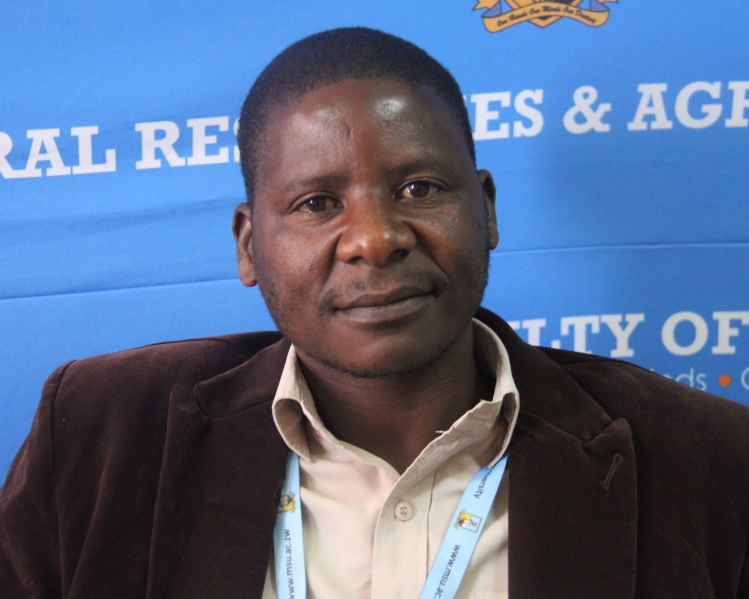
Dr Raymond Mugandani
Position: Senior Lecturer
Qualifications:
- PhD Crop Science, University of KwaZulu Natal, 2019
- MSc Agricultural Meteorology, University of Zimbabwe, 2007
- BSc Soil Science -Land and Water Management, University of Zimbabwe, 1996
Peer Reviewed Publications
- Tavengwa Chitata, Tirivashe Philip Masere, Bester Tawona Mudereri, Blessing Mirika Ndau, Solomon Farai Zirebwa, Batanai Lovemore Sammie, Rangarirayi Lucia Mhindu, Ngonidzashe Lewis Mufute, Kudakwashe Makwena, Dzikamai Chipunza, Joy Mufaro Sibanda, Augustine Mureri, Elvis Tawanda Mupfiga, Neil Mandinyenya Zhou & Raymond Mugandani. 2023. The Paradox of ‘Water Is Life’ in a Water Rationed City During the COVID-19 Pandemic
- Norman Mupaso, Godswill Makombe and Raymond Mugandani. 2023. Smallholder irrigation and poverty reduction in developing countries: A Review. Heliyon. IF 3.776
- Mugandani et al. Mapping and managing livelihoods vulnerability to droughts in Zimbabwe, Climate 2022, 10(12), 189; https://doi.org/10.3390/cli10120189
- Liboster Mwadzingeni, Raymond Mugandani, Paramu L Mafongoya. 2022. Gendered perception of change in prevalence of pests and management in Zimbabwe smallholder irrigation schemes. Agronomy for Sustainable Development.
- Liboster Mwadzingeni, Raymond Mugandani, Paramu L Mafongoya. 2022. Socio-demographic, institutional and governance factors influencing adaptive capacity of smallholder irrigators in Zimbabwe, PLOS ONE.
- Liboster Mwadzingeni, Raymond Mugandani, Paramu L Mafongoya. 2022. Socio-economic factors and water footprint in smallholder irrigation schemes of Zimbabwe. Water, doi: 10.3390/w1413210.
- Liboster Mwadzingeni, Raymond Mugandani, Paramu L Mafongoya. 2022. Risks of climate change on future water supply in smallholder irrigation schemes in Zimbabwe. Water: doi: 10.3390/w14111682.
- Calisto Gwatirisa. Calisto Gwatirisa. Bester Tawona Mudereri.,Tavengwa Chitata.,Concilia Mukanga.,Mary Mazvita Ngwenya.,John Muzvondiwa.,Raymond Mugandani.,Marvelous Sungirai, 2022. Microhabitat and patch selection detection from GPS tracking collars of semi-free ranging Mashona cattle within a semi-arid environment, Livestock Science journal.
-
M Zhou, C Dzingirai, K Hove, T Chitata, R Mugandani. 2022. Adoption, use and enhancement of virtual learning during COVID-19 Education and Information Technologies.
- Rodney T Muringai, Paramu Mafongoya, Romano T Lottering, Raymond Mugandani, Denver Naidoo. 2021. Unlocking the Potential of Fish to Improve Food and Nutrition Security in Sub-Saharan Africa. Sustainability.
- Mwadzingeni, L., Mugandani, R., and Mafongoya, P. 2021. Assessing vulnerability from climate change in smallholder irrigation schemes of Zimbabwe. Sustainability MDPI. 13, 10023. https://doi.org/ 10.3390/su131810023.
- Mugandani, R., Mwadzingeni, L and Mafongoya, P. Contribution of Conservation Agriculture to Soil Security Sustainability MDPI. 13, 9857. https://doi.org/10.3390/su13179857
- R. Mugandani., C. T. F Murewi, T. Chitata, F. Chipepa, B. T. Mudereri, L. Mwadzingeni and P. L. Mafongoya. 2021. Can the application of Item Response Theory improve the quality of survey items for assessing human fingerprint on climate change? , Transactions of the Royal Society of South Africa. DOI.10.1080/0035919X.2021.1964105.
- Muziri, Tavagwisa, Chaibva, Paul; Chofamba, Anyway; Madanzi, Tendai; Manjeru, Pepukai; Mudada, Nhamo; Manhokwe, Shephard; Mugari, Amiel; Matsvange, Diego; Murewi, Cyril Tapiwa Farai; Mwadzingeni, Liboster; Mugandani, Raymond. 2021. Using principal component analysis to explore consumers’ perception towards quinoa health and nutritional claims in Gweru, Zimbabwe. Journal of Food Science and Nutrition, (9) 1025–1033.
- Batanai Sammie, Elvis Mupfiga, Liboster Mwadzingeni, Tavengwa Chitata and Raymond Mugandani. (2021). A gendered lens to self-evaluated and actual climate change knowledge Journal of Environmental Studies and Science, 11 (1) 65-75
- Mugandani, R and Mafongoya, P. (2021).The 5As: Assessing Access to Animal-drawn Conservation Agriculture planting equipment by smallholder farmers. Environment, Development and Sustainability, 24(3), 4881-4898.
- Liboster Mwadzingeni, Raymond Mugandani, Paramu Mafongoya. (2020). Factors affecting the Performance of Tshiombo Irrigation Scheme in Limpopo Province, South Africa. Journal of Agribusiness and Rural Development, 3(57) 269–277.
- Liboster Mwadzingeni, Raymond Mugandani, Paramu Mafongoya. (2020) Localized Institutional actors and Smallholder Irrigation Scheme Performance in Limpopo Province of South Africa. Agriculture, 10 (418), 1-17.
- Mugandani, R and Mafongoya, P. (2019). Behaviour of smallholder farmers towards adoption of conservation agriculture in Zimbabwe. Soil Use and Management, 00, 1-15.
- Manatsa, D., Morioka, Y., Behera, S.K., Mushore, D.T and Mugandani, R (2015) Linking the Southern Annual Mode to the Diurnal Temperature Range Shifts over Southern Africa International Journal of Climatology. International Journal of Climate, 35, (14), 4220-4236
- Zirebwa, F.S., Sammie, B., Kapenzi, A and Mugandani, R (2014). An evaluation of the performance and subsequent calibration of two reference evapotranspiration estimation models for Gweru, Zimbabwe. Academia Journal of Agricultural Research, 2 (7): 167-174.
- Mugandani, R., Munodawafa. A., Zhou.N.M (2013) Promoting Carbon Sequestration through Participatory land Use Planning by Resource Poor Farmers. A Case Study in Arid Communal Areas of Zimbabwe. Ossrea Bulletin, Vol X, (1), 43 – 53
- Mugandani, R., Wuta, M., Makarau, A.., Chipindu, B. (2012 Re-classification of agro-ecological regions of Zimbabwe in conformity with climate variability and change. African Crop Science Journal, 20 (2), 361 – 369.
Refereed Book Chapters
- Makurira, H., Mugandani R., Dzvairo, W., Tawodzera, M., Shekede M.D., and Gwitira I. (2022). Vulnerability and adaptation assessment (chapter four) pages 58-90. Zimbabwe Fourth National Communication to the United Nations Convention on Climate Change (UNFCCC). Government of Zimbabwe, Ministry of Environment, UNEP, UNDP, 172pp. (Book Chapter)
- Murwira A., Mashonjowa E., Manatsa D., Mubaya C and Mugandani R. (2016). Vulnerability and Adaptation Assessment. Zimbabwe Third National Communication to the United Nations Convention on Climate Change (UNFCCC). GoZ, Ministry of Environment, Water and Climate, UNEP/UNDP.
- Murwira A., Masocha M., Gwitira I., Shekede M.D., Manatsa D and Mugandani R. (2012). Vulnerability and adaptation assessment (chapter four) pages 45-54. Zimbabwe Second National Communication to the United Nations Convention on Climate Change (UNFCCC). Government of Zimbabwe, Ministry of Environment, UNEP, UNDP, 142pp. (Book Chapter)
Refereed Technical Papers Manatsa D., Wuta M., Mushore TD., Chemura A., Mugandani R., Gwitira I., Shekede MD., Sakala C., Hasan L., Masukwedza L., Mupuro J.M. and Muzira N. Geo-spatial revision of agro ecological zones of Zimbabwe. Technical report 2020.
RESEARCH COMPETENCIES- Major Projects
1. Lead Consultant and Adaptation Expert: Initiative for Climate Action Transparency (ICAT) Project in Zimbabwe – Phase II (2024-2025). The Projects is developing the institutional arrangements for adaptation transparency reporting in Zimbabwe under the Enhaced Transparency Framewor (Zimbabwe – ICAT). Client – Ministry of Environment, Climate and Wildlife, Government of Zimbabwe and ICAT.
2. Team Leader and Adaptation Expert: First Biennial Transparency Report and Fifth National Communication to the UNFCCC (2024) and Second Biennial Transparency Report (2025-2026): Client- Ministry of Environment, Climate and Wildlife, Government of Zimbabwe and UNEP.
3. Co-author: Rights-based Approach to Climate Adaptation in Africa (2023-2025)- Client ACT ALLIANCE.
4. Lead Scientist: Situational Assessment in Bikita and Gutu districts, Zimbabwe (2024) – Client Zimbabwe Council of Churches
5. Lead Scientist: Assessment of the impact of Community and Environmental Assets and Effectiveness of Indigenous Knowledge Systems (IKS) on Climate Change Adaptation and Mitigation (2024): Client – Zimbabwe Council of Churches
6. Co-researcher: Enhancing the Capacity of Technical institutions Involved in the Provision of Climate Change Education, Training and Scientific Research Services in The COMESA Region (2021) – Client – University of Zimbabwe.
7. Lead Facilitator: Developing Curriculum, training material on Climate Change, sustainable agriculture, agroecology, Vulnerability, Resilience, and Mitigation (2024). Client – Caritas Gokwe.
8. Co-researcher: Zimbabwe Second (2012); Third (2016) and Fourth (2022) National Communication to the UNFCCC. Client- Government of Zimbabwe and UNEP.
9. Revision of Zimbabwe’s Agro-Ecological Zones (2020) : Client- Government of Zimbabwe and Research Council of Zimbabwe.
10. Lead facilittaor: Climate Change Mainstreaming Research (2021): Client – Ministry of Environment, Climate and Wildlife, Government of Zimbabwe.
11. Co-facilitator: Fostering a country-driven process to develop sustainable capacities of academia for a more holistic engagement in the Enhanced Transparency Framework (ETF) under the Paris Agreement: working with university educators in the agriculture and land- use (AFOLU) sectors in Zimbabwe (2022). Client – FAO.
12. Technical Patner: Sizimele: Action for Building Resilience in Zimbabwe (2017-2022): Client: Zimbabwe Resilience Building Fund (ZRBF).
Suggest a correction
If you'd like to suggest a correction for this profile and you are the owner use the edit button button below. For corrections to another person's profile contact the Webmaster on the email webmaster@staff.msu.ac.zw or call ext 3132
Edit Profile